
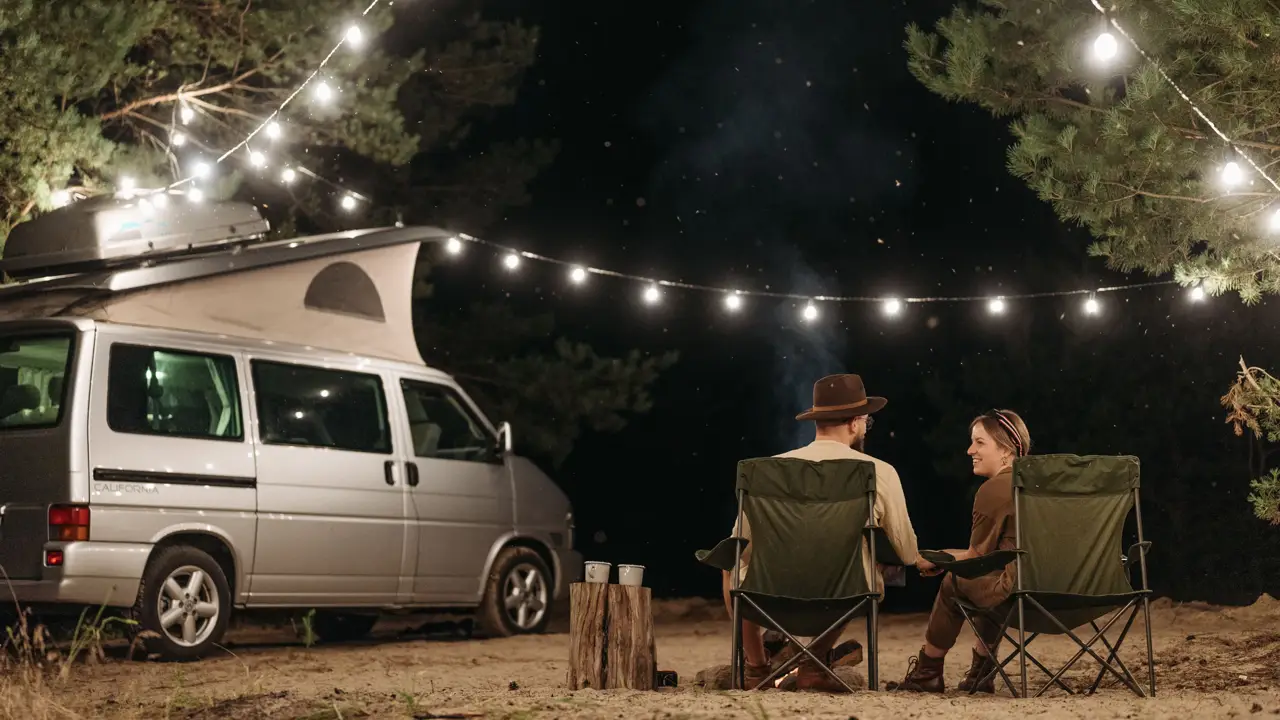
On a clear night at DeSoto Bluffs Campground near Fort Payne, Alabama, guests can enjoy a rich view of the southern Appalachian sky, especially when they step away from vehicle lights and campsite lanterns.
While some skyglow from nearby communities is visible toward the horizon, the campground’s higher elevation and relatively rural setting allow many of the brighter constellations and star patterns of the Northern Hemisphere to stand out overhead.
Finding Your Bearings: North, South, East, and West
To get oriented, first locate the northern sky and look for the distinctive shape of the Big Dipper, which is part of the constellation Ursa Major and circles around the North Star throughout the year.
Drawing an imaginary line through the two stars at the end of the Big Dipper’s bowl points toward Polaris, the North Star, which marks the direction of true north and sits above the horizon from the campground.
Once you have found north, you can easily identify the opposite direction as south, where many of the seasonal constellations climb high into the sky as the night progresses.
Winter and Early Spring Constellations
During winter and early spring evenings, one of the most recognizable patterns over DeSoto Bluffs is Orion the Hunter, with three bright stars lined up in a short, straight belt and a larger rectangle of stars forming his shoulders and knees.
- Orion – High in the southern sky on clear winter nights, with Betelgeuse (a reddish star) at one shoulder and Rigel (a bright blue-white star) at one foot.
- Canis Major – Just below and to one side of Orion, this constellation contains Sirius, the brightest star in the night sky, often twinkling strongly in the cool air.
- Taurus – Above or near Orion, Taurus the Bull includes the V-shaped Hyades star cluster and the bright star Aldebaran, as well as the small, misty patch of the Pleiades cluster nearby.
- Gemini – To one side of Orion, look for the twin stars Castor and Pollux marking the heads of the Twins, with fainter stars outlining their bodies.
These constellations form part of a larger pattern sometimes called the winter hexagon, a ring of bright stars that can be traced across the sky from the bluffs on long, crisp nights.
Spring and Early Summer Constellations
As the seasons shift toward spring, the familiar winter constellations sink earlier toward the western horizon from the campground, and new patterns rise higher in the eastern and southern sky.
- Leo – Leo the Lion is a key spring constellation, recognized by a backwards question mark or “sickle” of stars forming the lion’s head and mane, with a bright star marking the chest.
- Virgo – Sprawling across a large area of the sky, Virgo rises after Leo and is anchored by the bright star Spica, visible on clear nights from the open areas of the campground.
- Bootes – Near the handle of the Big Dipper, this kite-shaped constellation holds Arcturus, one of the brightest stars visible and a helpful landmark as the nights grow warmer.
On darker spring nights, away from direct lights, you may also notice more subtle star fields between these constellations, giving the sky above the bluffs a textured, three-dimensional appearance.
Summer Constellations and the Milky Way
In summer, the Milky Way arches more prominently across the sky over northeast Alabama, especially when humidity is low and you view from shadowed spots away from bright campsite lights.
- Cygnus – The Swan flies along the Milky Way, with its brightest star Deneb marking the tail and a cross-shaped set of stars forming the wings and body.
- Lyra – A small but important constellation, Lyra contains Vega, a brilliant blue-white star that is one corner of the Summer Triangle and often among the first stars visible at dusk.
- Aquila – The Eagle includes Altair, another point of the Summer Triangle, with a line of stars suggesting wings stretching across the glow of the Milky Way.
- Scorpius – Low toward the southern horizon, especially earlier in the summer evenings, this constellation resembles a hooked tail and can sometimes be seen from more open vantage points around the bluffs.
Together, Deneb, Vega, and Altair form the Summer Triangle high in the sky, serving as a bright guide to the band of the Milky Way above DeSoto Bluffs.
Autumn Constellations and Long Evenings
Autumn nights bring earlier darkness to the campground, giving guests more time to enjoy stargazing around campfires and from overlooks along the bluffs.
- Cassiopeia – Easily recognized as a W- or M-shaped line of five bright stars, Cassiopeia stands opposite the Big Dipper across Polaris and rides high in the northeastern sky in fall.
- Pegasus – The Great Square of Pegasus forms a large diamond-like shape that can be seen rising and then climbing higher through autumn evenings.
- Andromeda – Extending from one corner of the Great Square, Andromeda’s chain of stars leads to the region of the Andromeda Galaxy, which may appear as a faint, hazy patch from darker viewpoints.
These constellations give the autumn sky a wide, open feel above the tree line, and on especially transparent nights the dim glow of the Milky Way can still be traced across parts of the sky.
Tips for Enjoying the Night Sky at the Campsite
To see more stars and constellations from your campsite, turn off unnecessary lights, allow your eyes 15–20 minutes to adapt to the dark, and use a dim red flashlight if you need to move around.
- Choose a spot with an open view of the sky, such as an area with less overhead tree cover or a safe overlook near the bluffs.
- Start by finding easy patterns like the Big Dipper, Orion, or the Summer Triangle, then trace out nearby constellations from those anchor points.
- Revisit the sky in different seasons; the view above DeSoto Bluffs changes month by month as new constellations come into prime position.
Note: The exact constellations visible on any given night depend on the time of year, the time of night, and sky conditions, but many of the major Northern Hemisphere patterns described here can be enjoyed from DeSoto Bluffs over the course of a full year.
Planning a Night Under the Stars
- Plan your stay within about five days of the new moon so moonlight doesn't wash out the fainter stars.
- The Milky Way's bright core rises in the south: before dawn in spring, most of the night in midsummer, and in the early evening in early fall.
- Clear, low-humidity nights after a cold front give the crispest views.
- Give your eyes 20 to 30 minutes to adjust, and keep campsite lights low and pointed down so your neighbors can enjoy the view too.